
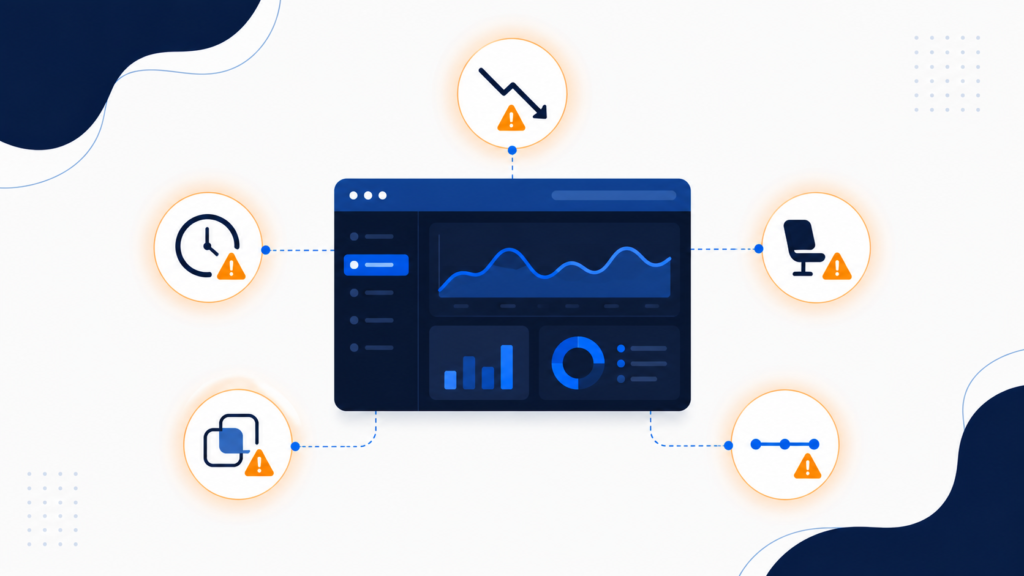
The hardest part of catching a failing rollout is that it rarely announces itself — signs your AI investment isn’t working tend to show up as small, easy-to-explain-away frustrations long before anyone calls it a failure outright. Workday’s global survey of 3,200 employees found that for every 10 hours of efficiency gained through AI, nearly 4 hours are lost to fixing its output — and only 14% of employees consistently achieve a genuinely net-positive result. That gap between reported time-saved and real net benefit is exactly where most quiet failures hide.
Here are five specific signs worth watching for, and what to actually do about each one.
Why These Signs Get Missed for Months
Most AI rollouts don’t fail loudly. They fail quietly, absorbed into everyone’s normal workload as "a bit more editing than expected" or "still figuring out the prompts" — explanations that sound reasonable individually but add up to a tool that’s never actually delivering its promised value.
Catching this early matters because the cost isn’t just the subscription. It’s the team’s time, the opportunity cost of not trying a better-fit tool, and the credibility AI initiatives lose internally every time one quietly underdelivers.
How to Spot Signs Your AI Investment Isn’t Working
- Compare against your actual baseline, not a vague sense of "it feels faster."
- Ask the people using it daily, not just whoever championed the purchase.
- Check usage data, not just the invoice. A tool nobody logs into is failing regardless of its feature list.
- Look at review and correction time specifically, not just the raw output speed.
- Give it a real, defined evaluation point instead of letting an underperforming tool linger indefinitely.
5 Signs Your AI Investment Isn’t Working
1. Usage Is High, but Nobody Can Point to a Result
If a team logs in daily but can’t answer "what did this actually save us this month," that’s one of the clearest signs your AI investment isn’t working — activity without a traceable outcome. Fix: define one specific metric the tool should move, and check it against your baseline directly.
2. The "Time Saved" Keeps Getting Eaten by Editing
A draft that takes 5 minutes to generate but 25 minutes to fix isn’t actually saving time — it’s just moving the work around. Fix: track review and correction time explicitly, not just generation speed, and compare the full loop against the old manual process.
3. Only One or Two People Ever Actually Use It
A tool purchased for a whole team but adopted by a fraction of it is quietly failing at the rollout stage, regardless of how well it performs for the few who do use it. Fix: find out specifically why adoption stalled — training gap, unclear use case, or a tool that doesn’t fit the actual workflow.
4. It’s Duplicating Work Another Tool Already Does
Paying for two tools that both draft emails, or both summarize meetings, is a cost problem dressed up as a productivity investment. Fix: audit your current AI stack for overlap before renewing anything, and consolidate to the stronger option.
5. Nobody Set a Deadline to Actually Evaluate It
Tools without a defined review date tend to just persist by default, whether or not they’re working — this is often the real reason a struggling tool survives multiple renewal cycles unchallenged. Fix: set a specific 60-90 day review date at launch, not after concerns are already being raised.
Diagnosing Which Sign Applies to Your Team
Here’s a simple way to think through the checklist above — five distinct symptoms, each with a genuinely different underlying cause and fix.

| Sign | Root Cause | Fix |
|---|---|---|
| High usage, no result | No defined success metric | Set one metric and track against baseline |
| Time saved gets eaten by editing | Only tracking generation speed | Measure the full review loop |
| Low team adoption | Training gap or poor workflow fit | Diagnose the specific adoption blocker |
| Overlapping tools | No audit before renewal | Consolidate to the stronger tool |
| No evaluation date | Default renewal, no review trigger | Set a fixed 60-90 day check-in |
Common Mistakes That Let These Signs Go Unnoticed
- Only checking in with whoever championed the tool, not the people actually using it daily.
- Treating "we’re using it a lot" as proof it’s working.
- Never comparing against the original baseline the tool was supposed to improve.
- Letting a struggling tool renew automatically without a scheduled evaluation point.
- Not asking directly whether editing time has quietly grown alongside the reported time savings.
Frequently Asked Questions
What’s the most common sign your AI investment isn’t working?
High usage with no traceable result — a team logging in regularly but unable to point to a specific number that actually moved. It’s the most common because it hides behind the appearance of engagement.
How soon should I check for these warning signs?
Within the first 60-90 days, and again at each renewal point. Waiting longer than a full billing cycle usually means the tool has already become a habit nobody questions.
Does a failing tool mean AI itself isn’t worth it?
No — it usually means the specific tool, use case, or rollout process needs adjusting, not that AI broadly doesn’t work. Most fixes here are process fixes, not reasons to abandon AI entirely.
Conclusion
None of these five signs your AI investment isn’t working require guesswork to catch — they show up in usage data, editing time, and a simple conversation with the people actually using the tool. Run through the checklist above this month, and fix the specific cause rather than renewing on autopilot. For the full measurement framework behind these signs, see our pillar guide on how to measure AI ROI in your business.
📌 This article is part of our Business Growth Strategies series on ROI. It supports our pillar guide, How to Measure AI ROI in Your Business, and pairs with AI ROI by Department for the metrics to track once a tool is confirmed to be working.