

Growing businesses eventually hit this decision, often without a clear framework for making it — when to hire vs automate with AI shouldn’t come down to which one feels easier this quarter. Deloitte’s 2026 State of AI in the Enterprise report found that the AI skills gap is now seen as the biggest barrier to integration, and education — reskilling existing people — was the number one way companies adjusted their talent strategy in response, ahead of new hiring or workflow redesign.
That finding hints at the real answer: this usually isn’t a strict either/or choice. This guide covers how to actually make the call, task by task.
Why This Decision Gets Made Reactively More Often Than It Should
Hiring and automating both solve a capacity problem, which makes them feel interchangeable in the moment a team is overwhelmed. But they solve different kinds of capacity — automation multiplies existing judgment on repetitive tasks; hiring adds new judgment entirely. Confusing the two leads to hiring for work that should have been automated, or automating work that genuinely needed a human decision-maker.
Getting this right matters financially too — a bad hire is expensive and slow to unwind, while over-automating judgment-heavy work creates quality problems that are just as costly, if quieter.
How to Decide When to Hire vs Automate With AI
- Is the bottleneck volume, or judgment? Volume favors automation; judgment favors hiring.
- Is the task well-defined and repetitive, or does it require weighing context AI can’t fully see?
- Would automating this task free up time for the kind of work only a new hire could otherwise do?
- Is the skills gap a training problem or a capacity problem? Per Deloitte’s research, reskilling solves more of this than most teams assume.
- What’s the cost of being wrong, comparing a reversible automation pilot against a much harder-to-reverse hire?
A Framework for When to Hire vs Automate With AI
Automate When the Bottleneck Is Volume, Not Judgment
Repetitive, well-defined tasks that simply take too many hours are the clearest automation candidates — drafting, data entry, first-pass triage. If the task doesn’t require weighing context or making a judgment call, automation usually solves it faster and cheaper than a new hire would.
Hire When the Bottleneck Is Judgment or Relationship-Building
Strategy, complex client relationships, and decisions requiring genuine context that AI can’t infer are where a hire beats automation, regardless of how much volume is involved. Trying to automate around this bottleneck usually just produces lower-quality decisions faster, not better ones.
Reskill Before Assuming You Need Either
Deloitte’s research points to something most companies underweight: the AI skills gap is frequently a training problem, not a headcount problem. Before deciding when to hire vs automate with AI, check whether an existing team member could close the gap with focused training — often the fastest, cheapest option of the three.
Hiring vs Automation, Side by Side
Here’s a simple way to weigh the two against the specific bottleneck you’re facing.
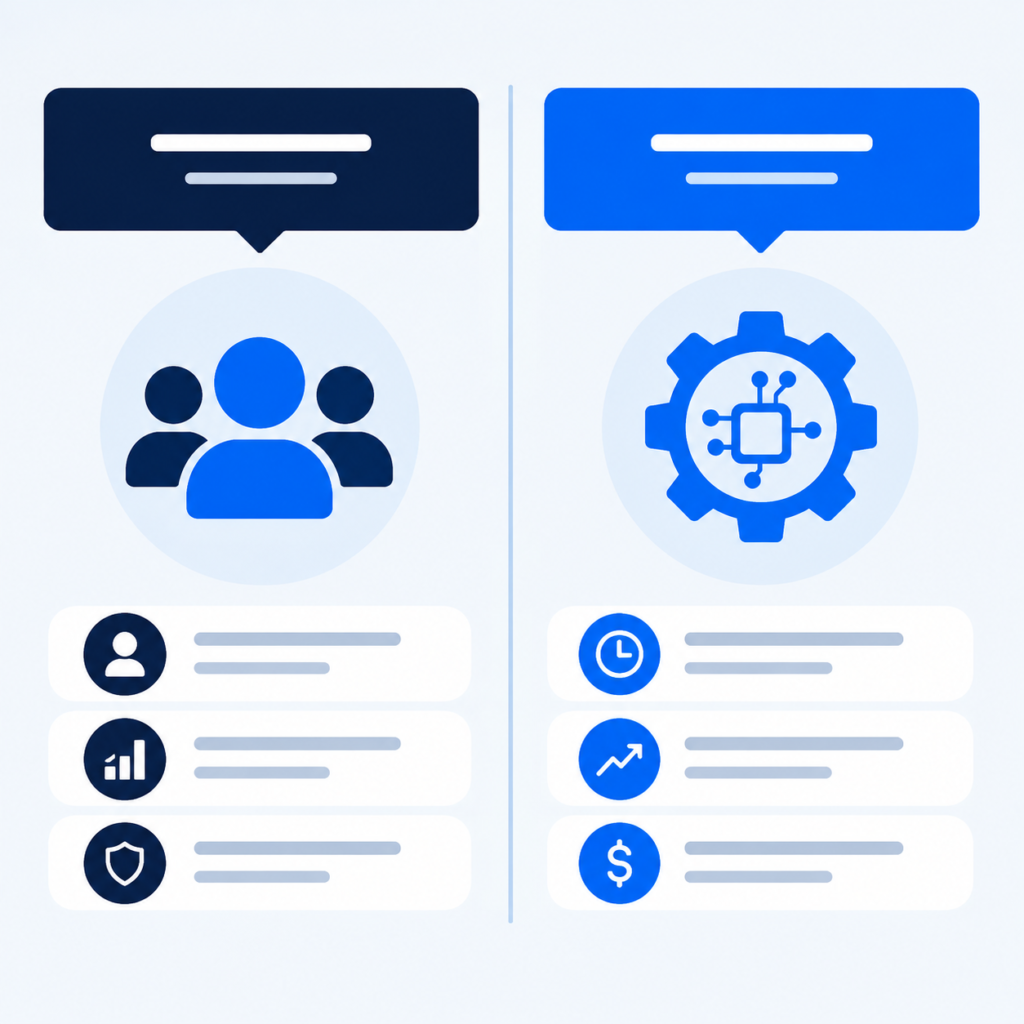
| Signal | Favors Hiring | Favors Automating |
|---|---|---|
| Type of bottleneck | Judgment, relationships | Volume, repetition |
| Task definition | Context-dependent, variable | Well-defined, repeatable |
| Cost of being wrong | High, hard to reverse | Lower, easy to pilot |
| Root cause | Genuine capacity gap | Skills or process gap |
Common Mistakes in the Hire vs Automate Decision
- Automating judgment-heavy work because it feels faster than hiring, then absorbing the quality cost later.
- Hiring for a purely repetitive task that a well-set-up automation would have handled at lower cost.
- Skipping the reskilling option entirely, jumping straight to hire-or-automate without checking it.
- Making the decision reactively during a busy period instead of as a deliberate evaluation.
- Not revisiting the decision as a task or team’s needs change over time.
Frequently Asked Questions
Is it usually cheaper to automate than to hire?
For volume-driven, repetitive tasks, generally yes. For judgment-heavy or relationship-driven work, automating often costs more in quality than it saves in salary, once you account for the downstream cost of mistakes.
Can reskilling really replace the need to hire or automate?
Sometimes — Deloitte’s research found it was the top talent-strategy response to the AI skills gap in 2026, ahead of new hiring, which suggests it’s more viable than most teams initially assume.
What’s the biggest mistake in deciding when to hire vs automate with AI?
Making the call reactively, under pressure, rather than checking whether the actual bottleneck is volume, judgment, or simply a skills gap that training could close.
Conclusion
The real answer to when to hire vs automate with AI usually isn’t either one exclusively — it’s matching the specific bottleneck to the right response: automation for volume, hiring for judgment, and reskilling for gaps that training can close faster than either. Run your next capacity decision through that framework before defaulting to whichever option feels most familiar.
📌 This article completes our Business Growth Strategies series on scaling. It supports our pillar guide, How to Scale Your Business With AI, and pairs with How Your AI Stack Evolves From Startup to Established Business for the tooling side of the same growth.