
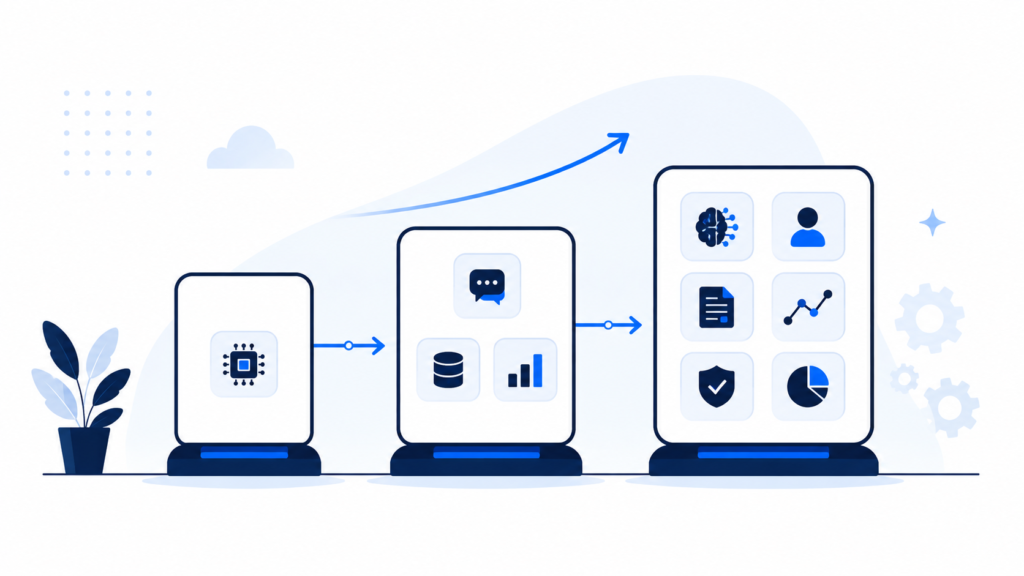
The tools that got you here won’t necessarily get you to the next stage — how your AI stack evolves as a business grows follows a fairly predictable pattern. SMB Group research found that 42% of small and mid-sized businesses (50-499 employees) now use AI in at least one business process, up sharply from 23% in 2024 — and that growth in adoption tends to track a business’s own growth in size and complexity, not happen all at once.
This guide maps that evolution across three stages, so you can recognize when your current stack has become the bottleneck rather than the advantage it used to be.
Why Your Stack Needs to Change as You Grow
A single general-purpose AI assistant covers a huge share of what a five-person startup needs. That same setup usually breaks down somewhere between 15 and 50 employees, when different departments develop genuinely different needs, and a one-tool-fits-all approach starts creating more workarounds than it solves.
Recognizing that shift early — rather than after the workarounds pile up — is what separates a smooth stack evolution from a disruptive one.
How Your AI Stack Evolves: What Changes at Each Stage
- Team size and department differentiation is the biggest driver — different functions start needing different tools.
- Data volume and complexity grow, often faster than headcount, straining tools built for a simpler starting point.
- Compliance and governance needs increase, especially once customer data volume crosses certain thresholds.
- Budget shifts from "any tool that helps" to ROI-justified decisions as spend becomes visible at the leadership level.
- Integration needs multiply as more tools need to share data rather than operate in isolation.
3 Stages of AI Stack Evolution
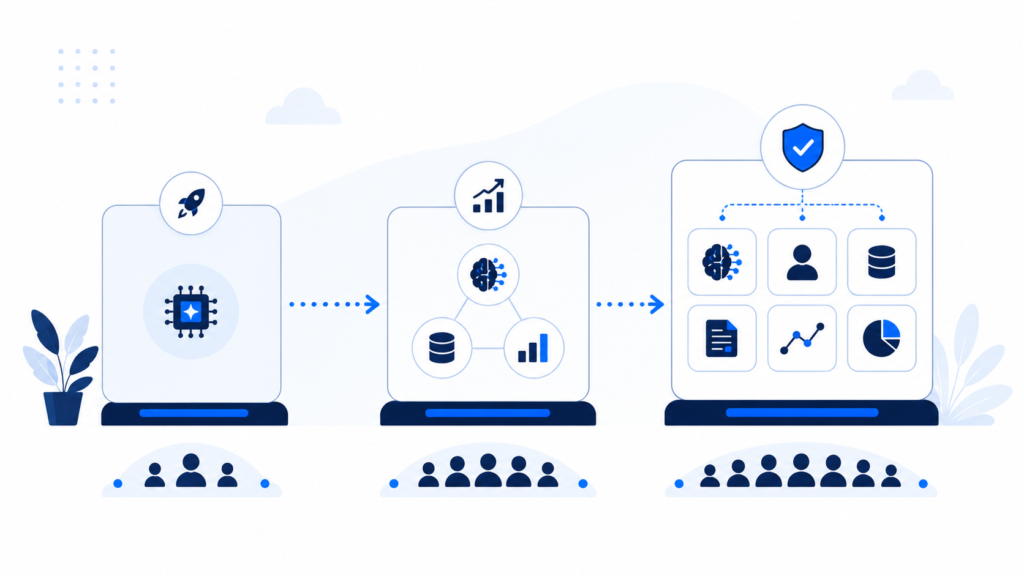
Startup: One General Assistant Covers Almost Everything
At the earliest stage, a single AI assistant — handling writing, research, and quick analysis — typically covers most needs across a tiny team wearing multiple hats. Specialization isn’t worth the overhead yet; the bottleneck is usually knowing what to automate at all, not which specific tool to pick.
Growing: Department-Specific Tools Start Appearing
As the team splits into functions — marketing, sales, support — each starts adopting its own specialized tool rather than stretching the general assistant to cover everything. This is where how your ai stack evolves starts to genuinely diverge by department, and where the first real integration headaches typically appear if tools aren’t chosen with data-sharing in mind.
Established: Governance and Integration Become the Priority
At this stage, the question shifts from "what tool solves this" to "how do all our tools work together, safely, at our current scale." Formal AI usage policies, vendor due diligence, and integrated data flows between tools become necessary rather than optional — the informal habits that worked at ten people create real risk at a hundred.
The Three-Stage AI Stack Timeline
Here’s how that progression typically looks, from one flexible tool to a governed, integrated stack.
| Stage | Typical Stack | Main Bottleneck |
|---|---|---|
| Startup | One general assistant | Knowing what to automate |
| Growing | Department-specific tools | Integration between tools |
| Established | Governed, integrated stack | Policy and vendor oversight |
Common Mistakes When Your Stack Should Be Evolving
- Sticking with the startup-era single tool long after departments have genuinely different needs.
- Adding department tools without planning integration, creating disconnected data silos.
- Waiting until a compliance issue forces governance, instead of building it in as the team grows.
- Adding tools reactively, one urgent need at a time, instead of periodically reviewing the whole stack.
- Not revisiting vendor agreements as data volume and sensitivity increase with growth.
Frequently Asked Questions
At what company size should I start specializing my AI tools?
Somewhere between 15 and 50 employees is a common inflection point, though it depends more on department differentiation than headcount alone — once teams need genuinely different workflows, that’s the real signal.
How your AI stack evolves — does it ever stop changing?
No, though the pace slows. Established businesses still periodically add, replace, or consolidate tools, just with more formal evaluation than an early-stage team typically has time for.
What’s the biggest mistake growing businesses make with their AI stack?
Adding tools reactively, one urgent need at a time, without ever stepping back to review the whole stack for overlap or integration gaps.
Conclusion
Understanding how your AI stack evolves — from one flexible assistant, to department-specific tools, to a governed and integrated system — helps you make the next change deliberately instead of reactively. Recognize which stage your business is actually in today, and plan the next shift before your current stack becomes the bottleneck.
📌 This article is part of our Business Growth Strategies series on scaling. It supports our pillar guide, How to Scale Your Business With AI, and pairs with When to Hire vs When to Automate More With AI for the people side of this same growth.