
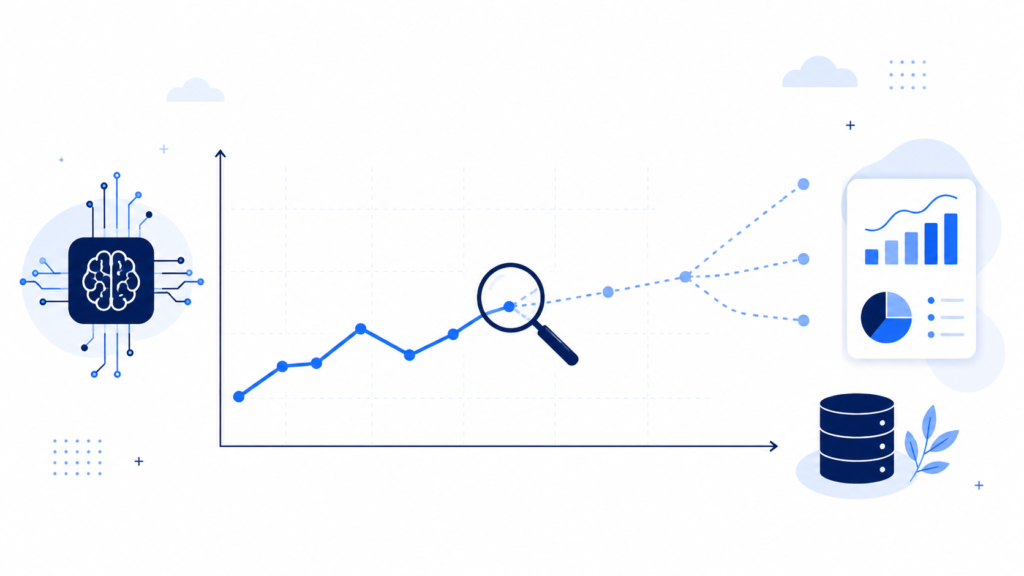
Forecasting used to mean a quarterly spreadsheet exercise everyone dreaded — the best AI tools for financial forecasting are turning it into something closer to continuous. Adoption is accelerating fast: Wolters Kluwer’s Future Ready Accountant report found AI adoption among tax and accounting firms rose from 9% in 2024 to 41% in 2025, with forecasting and cash flow modeling among the fastest-growing use cases as firms redirect freed-up time toward advisory work.
This guide covers the forecasting tools worth considering, and how to use them without treating a model’s output as a guarantee.
Why Forecasting Benefits Especially From AI
Traditional forecasting relies on a handful of assumptions updated manually, often infrequently, by whoever has time between closing the books. AI-assisted forecasting can incorporate more variables, update more frequently, and model multiple scenarios simultaneously — turning a static best-guess into something that adjusts as new data actually comes in.
That doesn’t make it infallible. A forecasting model is only as good as the historical data and assumptions feeding it, which is exactly why human judgment still belongs in the loop, especially for anything strategic.
How to Choose the Best AI Tools for Financial Forecasting
- Does it model multiple scenarios, or just a single projected line?
- How far back does its historical data need to go to produce reliable output?
- Does it integrate directly with your accounting data, or require manual data exports?
- Can you see and adjust its underlying assumptions, or is it a black box?
- Does it update continuously, or only when someone manually refreshes it?
Best AI Tools for Financial Forecasting, by Platform
Pigment — Best for Scenario Planning at Scale
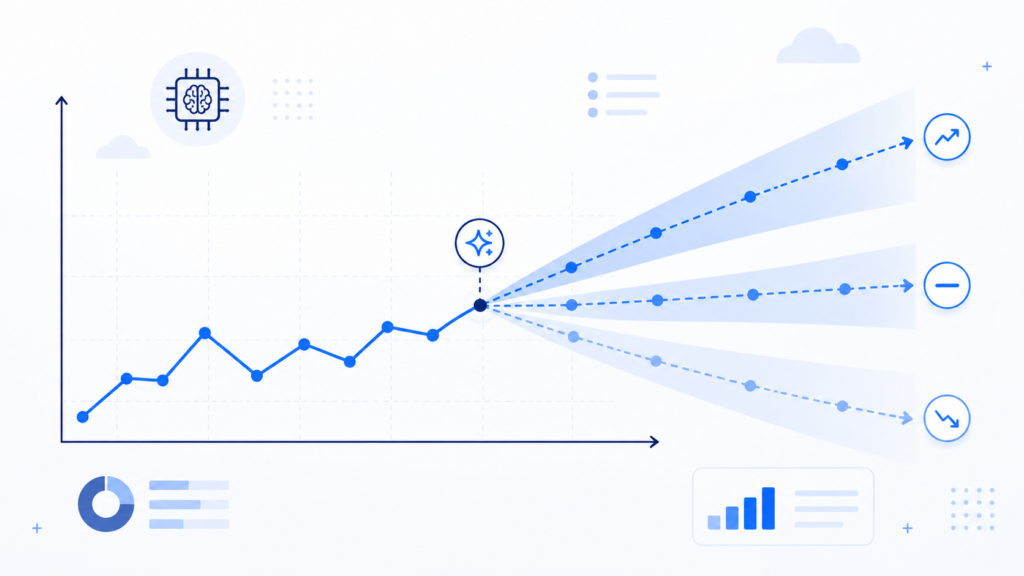
Pigment specializes in flexible, multi-scenario financial modeling, letting finance teams compare best-case, base-case, and downside projections side by side rather than committing to a single forecast.
Jirav — Best for Small Business Cash Flow Forecasting
Jirav focuses specifically on cash flow forecasting for smaller businesses, integrating directly with accounting platforms to keep projections current without a separate manual data-pull process.
Datarails — Best for Excel-Native Forecasting
Datarails layers AI-driven forecasting onto existing Excel-based financial models, appealing to finance teams reluctant to abandon spreadsheets entirely while still wanting automated, continuously updated projections.
What Scenario-Based Forecasting Actually Looks Like
Here’s how the strongest forecasting tools model uncertainty, rather than presenting one single "answer."
| Tool | Best For | Core Strength |
|---|---|---|
| Pigment | Multi-scenario planning | Side-by-side scenario comparison |
| Jirav | Small business cash flow | Direct accounting integration |
| Datarails | Excel-native teams | AI layered onto existing models |
Common Mistakes With AI Financial Forecasting
- Treating a forecast as a guarantee instead of a model built on assumptions worth reviewing.
- Feeding it incomplete or inconsistent historical data, compounding into unreliable projections.
- Never comparing forecast to actual results to check whether the model is calibrated correctly.
- Choosing a black-box tool whose underlying assumptions can’t be inspected or adjusted.
- Modeling only a single scenario instead of a realistic range of outcomes.
Frequently Asked Questions
What are the best AI tools for financial forecasting?
Pigment leads for multi-scenario planning at scale, Jirav for small business cash flow specifically, and Datarails for teams wanting to keep an Excel-based workflow. The right pick depends on your team size and current tools.
How accurate are AI financial forecasts?
Accuracy depends heavily on data quality and the reasonableness of underlying assumptions — treat any forecast as a planning tool to stress-test, not a guaranteed outcome, and compare it against actuals regularly.
Do I need a data science background to use these tools?
No — most modern forecasting platforms are built for finance teams without a technical background, with the modeling complexity handled behind a straightforward interface.
Conclusion
The best AI tools for financial forecasting turn planning from an occasional spreadsheet exercise into something continuously updated and scenario-aware — but the model is only as good as the data and assumptions behind it. Start with a tool that integrates cleanly with your existing accounting data, and keep a human reviewing the assumptions. For the full finance picture, see our pillar guide to best AI tools for finance and accounting.
📌 This article is part of our Best AI Tools series on finance. It supports our pillar guide, Best AI Tools for Finance and Accounting in 2026, and pairs with Best AI Tools for Invoicing and Expense Management for keeping the underlying data clean.