
Manual invoice processing is disappearing faster than most other back-office tasks — the best AI tools for invoicing and expenses are riding a genuinely large wave. The accounts payable automation market reached $6.94 billion in 2026 according to Mordor Intelligence’s industry analysis, and small and medium businesses are now the fastest-growing segment, expanding at an 18.15% annual rate as e-invoicing mandates spread globally.
This guide covers the tools actually worth using for this specific job — capturing, categorizing, and approving invoices and expenses without the manual data entry that used to define it.
Why Invoicing and Expenses Are a High-Leverage Starting Point
Unlike forecasting or strategic finance work, invoicing and expense management is highly repetitive and rules-based — the same document types, the same categories, the same approval logic, over and over. That consistency makes it one of the most reliable places to see fast, measurable AI ROI, which is exactly why it’s often the first finance function businesses automate.
It’s also low-risk relative to other finance AI use cases: mistakes here are usually caught and correctable before money actually moves, unlike an error in forecasting or tax filing.
How to Choose the Best AI Tools for Invoicing and Expenses
- Does it handle capture, categorization, and approval, or just one piece of the workflow?
- Does it integrate with your accounting software and bank feeds directly?
- How accurate is its categorization against your specific chart of accounts?
- Does it support your region’s e-invoicing requirements, if applicable?
- What’s the real cost per invoice or expense processed, not just the flat monthly fee?
Best AI Tools for Invoicing and Expenses, by Platform
Bill.com — Best for AP Automation at Scale
Bill.com’s AI features handle invoice capture, coding, and approval routing, making it a common choice for businesses processing a high volume of vendor invoices that need a defined approval chain.
Ramp — Best for Combined Card and Expense Management
Ramp pairs corporate card issuance with AI-driven expense categorization and policy enforcement in one platform, reducing the gap between spending and recording that separate card and expense tools often create.
Expensify — Best for Simple Receipt Capture
Expensify’s AI-assisted receipt scanning and categorization remains one of the most accessible entry points for expense management, particularly for smaller teams that don’t need Ramp’s card-issuance layer.
QuickBooks AI — Best for Teams Already on QuickBooks
QuickBooks' built-in AI features handle invoice matching and categorization within a system many small businesses already use for core bookkeeping, which is one of the more reliable best ai tools for invoicing and expenses choices when you want to avoid adding a separate platform entirely.
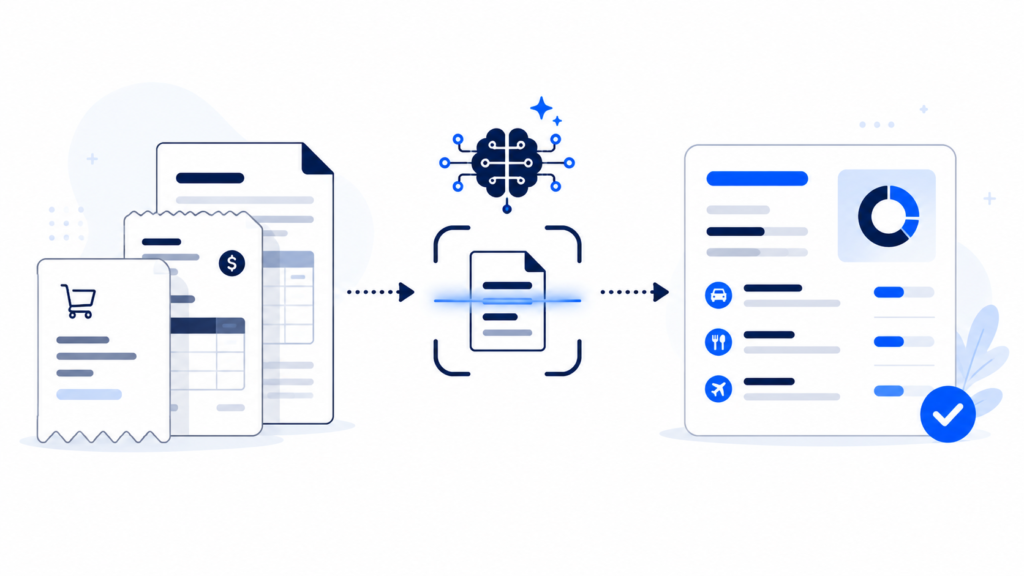
From Receipt to Approved Expense
Here’s what that automated capture-to-approval workflow actually looks like once it’s set up.

| Tool | Best For | Core Strength |
|---|---|---|
| Bill.com | High-volume AP automation | Approval routing at scale |
| Ramp | Combined card + expense management | Real-time policy enforcement |
| Expensify | Simple receipt capture | Accessible for small teams |
| QuickBooks AI | Teams already on QuickBooks | No separate platform needed |
Common Mistakes With AI Invoicing and Expense Tools
- Not customizing categorization rules to your specific chart of accounts before relying on it.
- Skipping approval workflow setup, leaving spend policy unenforced.
- Choosing a tool that doesn’t sync with your core accounting software.
- Ignoring regional e-invoicing requirements when operating across multiple countries.
- Trusting auto-categorization blindly without a periodic accuracy spot-check.
Frequently Asked Questions
What are the best AI tools for invoicing and expenses?
Bill.com leads for high-volume AP automation, Ramp for combined card and expense management, and QuickBooks AI for teams wanting to avoid adding a separate platform. The right pick depends on your existing accounting stack.
How accurate is AI expense categorization?
Generally high for common categories after initial setup, but accuracy improves further once the tool has learned your specific chart of accounts — a brief customization period pays off quickly.
Is AI invoicing worth it for a small business with low volume?
Often yes, even at modest volume, since the time saved per invoice compounds and most tools offer pricing tiers proportional to volume rather than flat enterprise rates.
Conclusion
The best AI tools for invoicing and expenses are the ones that match your actual volume and existing accounting stack, not the platform with the longest feature list. Start with whichever tool integrates cleanest with what you already use, and expand from there. For the full finance picture, see our pillar guide to best AI tools for finance and accounting.
📌 This article is part of our Best AI Tools series on finance. It supports our pillar guide, Best AI Tools for Finance and Accounting in 2026, and pairs with Best AI Tools for Financial Forecasting for planning ahead once the books are current.