
Most businesses can’t answer a simple question about their own AI spending: is it actually working? Learning how to measure AI ROI in your business has become urgent precisely because so few companies do it well — according to a July 2026 Forbes analysis citing PwC’s 2026 Global CEO Survey of 4,454 executives across 95 countries, only 12% of CEOs report seeing both higher revenue and lower costs from AI, while more than half report no measurable financial effect at all.
The gap usually isn’t the technology. It’s that most businesses track how much they use AI without ever connecting that usage to an actual number that matters. This guide covers how to close that gap.
Why Most Businesses Measure AI Usage, Not AI Value
It’s easy to track adoption — logins, messages sent, tickets touched by AI. It’s much harder to connect that activity to revenue, cost, or time genuinely saved, which is exactly why most ROI conversations stall at "we’re using it a lot" instead of "here’s what it’s worth."
That distinction matters because usage and value aren’t the same thing. A team can be heavy AI users and still show zero measurable financial impact if nobody defined what "working" would actually look like before rolling the tool out.
How to Measure AI ROI in Your Business: The Framework
Before evaluating any specific tool, put these pieces in place:
- Set a baseline before you start. You can’t measure improvement against a number you never recorded.
- Separate efficiency metrics from financial ones. Hours saved is real, but it isn’t revenue or margin until you connect it to one.
- Track adoption and outcomes separately. High usage with flat outcomes is a real, common pattern worth catching early.
- Give it a defined measurement window. 60-90 days is usually enough to see a genuine signal without over-reacting to noise.
- Account for hidden costs, including the time spent reviewing and correcting AI output, not just the subscription price.
4 Components of a Real AI ROI Measurement
Choose the Right Baseline Metrics
Before deploying anything, record the current state of whatever you expect to change — average response time, hours spent on a task, conversion rate. Without this, any improvement claim afterward is really just an impression, not a measurement.
Separate Efficiency From Revenue Impact
Time saved is a legitimate, valuable metric, but it’s not automatically the same as revenue growth or cost reduction. Learning how to measure AI ROI in your business properly means tracing efficiency gains through to where they actually show up financially — reassigned hours, faster deal cycles, reduced staffing need — rather than stopping at "we’re faster now."
Track Adoption and Outcomes as Two Separate Numbers
High usage doesn’t guarantee results, and low usage with strong results from a small pilot group is still a meaningful signal. Reporting these as one blended number hides exactly the information that matters most for deciding whether to expand.
Account for the Hidden Cost of Fixing AI Output
Efficiency gains on paper can shrink fast once someone accounts for review and correction time. Any honest ROI measurement needs to net out that cost, not just count the raw hours a tool claims to save.
A Simple Framework for Measuring AI ROI
Here’s how these four pieces connect into one repeatable measurement process, from baseline to outcome.
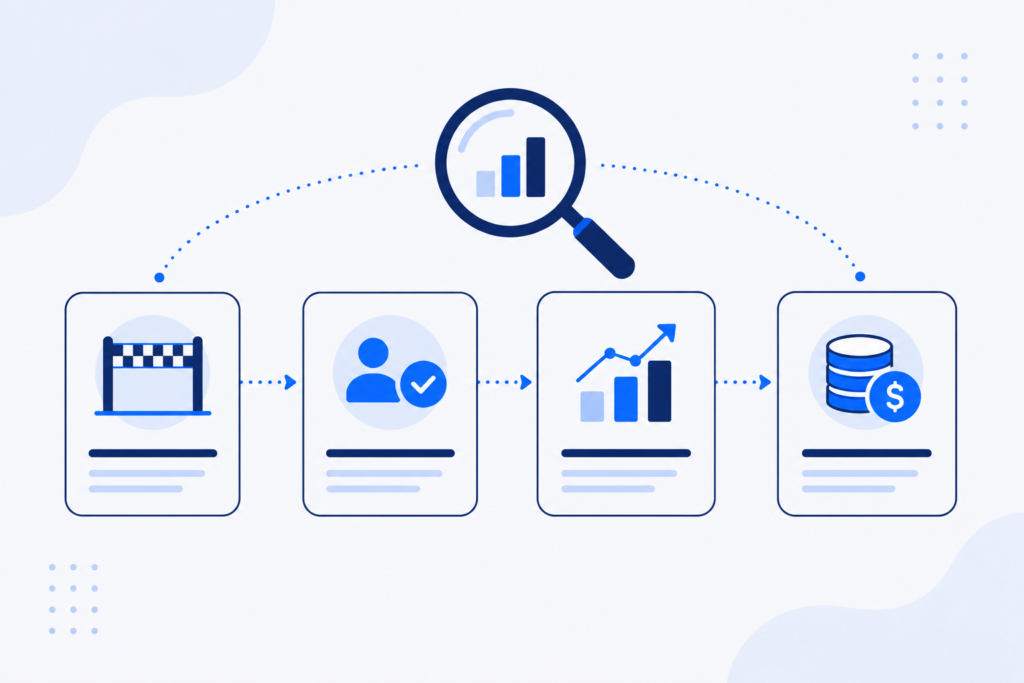
| Metric Type | What It Measures | Example |
|---|---|---|
| Baseline | Pre-AI state of the process | Average hours per report before AI |
| Adoption | How much the tool is actually used | Weekly active users, tasks completed |
| Outcome | The financial or time result | Hours saved, faster response time |
| Net cost | Subscription plus review/correction time | True cost after hidden overhead |
This framework applies across every department, but the specific numbers worth tracking differ by function — our companion guide on AI ROI by department breaks down exactly what to measure in marketing, sales, and support. If your numbers already look concerning, see our guide to 5 signs your AI investment isn’t working.
Common Mistakes When Measuring AI ROI
- Never recording a baseline before rolling out a new tool.
- Reporting adoption as if it were the same thing as value.
- Ignoring the time spent correcting AI output when calculating net time saved.
- Measuring too early, before a tool has had a fair window to actually change behavior.
- Tracking a different metric than the one the tool was actually meant to move.
Frequently Asked Questions
How long should I wait before measuring AI ROI?
Most teams see a meaningful signal within 60-90 days. Measuring sooner often reflects a novelty effect rather than a stable, lasting change in outcomes.
What’s the biggest reason companies can’t answer how to measure AI ROI in their business?
Skipping the baseline. Without a "before" number, any claimed improvement afterward is an impression, not a measurement — and it’s the single most common gap according to recent CEO-level surveys.
Is usage a good enough proxy for ROI?
No. High usage with no measurable outcome change is a common, real pattern — usage and value need to be tracked as separate numbers, not treated as interchangeable.
Conclusion
Most businesses can tell you how much they use AI. Few can tell you what it’s actually worth — and closing that gap is exactly what learning how to measure AI ROI in your business comes down to: a real baseline, a defined window, and outcomes tracked separately from adoption. Apply the framework above to one process this quarter before expanding further.
📌 This is the pillar guide for our Business Growth Strategies series on ROI. Go deeper with AI ROI by Department and 5 Signs Your AI Investment Isn’t Working.