
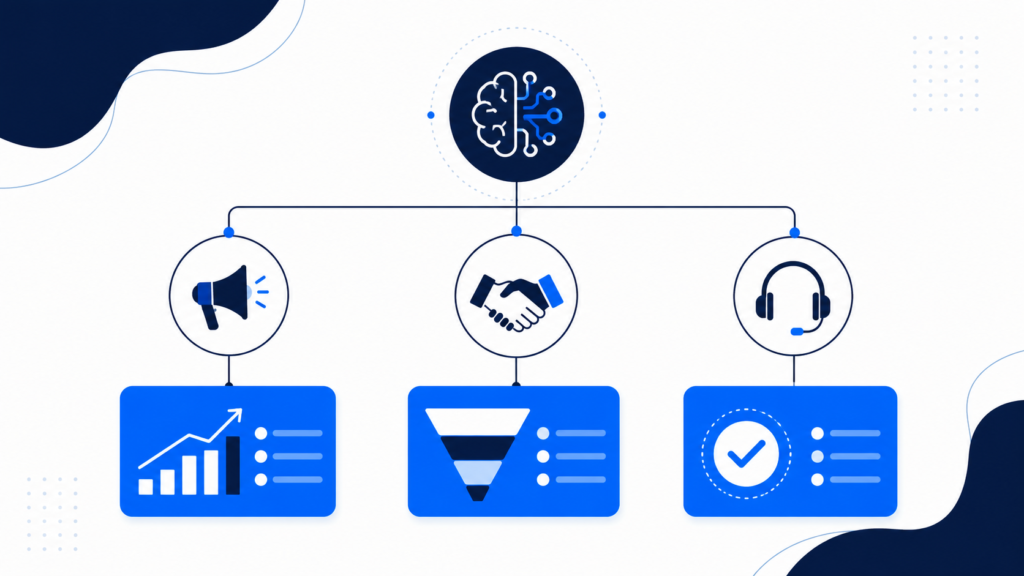
AI ROI by department looks nothing alike across a business, which is exactly why a single company-wide number rarely tells the real story. Forbes Research’s 2025 AI Survey found that half of companies measure AI success through data quality improvements and 48% through employee productivity — but far fewer connect that activity to P&L or margin impact, the metric that actually determines whether a department’s AI spend was worth it.
This guide breaks that gap down by function: what to actually measure in marketing, sales, and support, so each department’s number means something concrete.
Why One Company-Wide ROI Number Hides the Real Picture
A blended AI ROI figure can look flat even when one department is seeing strong results and another is seeing none — the average just cancels them out. Measuring by department surfaces which specific use case is actually working, which is the information you need to decide where to expand versus where to cut.
It also matches how AI is actually deployed in most businesses: as scattered, department-specific tools rather than one unified platform, which means the ROI conversation has to happen at that same level to be meaningful.
How to Measure AI ROI by Department
- Pick metrics the department already tracks, so you’re adding a column, not building a new reporting system from scratch.
- Tie the metric to a dollar figure where possible — cost per lead, revenue per rep, cost per resolved ticket.
- Give each department its own baseline, since starting points vary widely by function.
- Compare against the specific tool’s stated purpose, not a generic productivity number.
- Report department numbers separately before rolling them into any company-wide figure.
AI ROI by Department, Function by Function
Marketing: What to Measure
Content output per hour, cost per piece of content, and time-to-publish are the clearest early signals for marketing AI ROI. Longer-term, track whether AI-assisted content actually performs — traffic, engagement, conversion — not just whether it got published faster. Our guide to the best AI tools for marketing covers the specific platforms these numbers usually apply to.
Sales: What to Measure
Lead response time, deals touched per rep, and forecast accuracy are the metrics most directly tied to AI ROI by department in a sales context. A shorter response time is only meaningful if it’s also moving conversion rate — track both together, not just the speed number in isolation. See our guide to the best AI tools for sales teams for the tools behind these gains.
Support: What to Measure
First-response time, tickets resolved without escalation, and CSAT are the core numbers for support. Deflection rate alone can be misleading — a high deflection rate with falling CSAT usually means customers are being pushed away from human help before their issue is actually solved. Our best AI tools for customer service guide covers the platforms most relevant here.
| Department | Primary Metric | Watch-Out Metric |
|---|---|---|
| Marketing | Cost per piece of content | Actual content performance, not just output volume |
| Sales | Lead response time | Conversion rate, not just speed alone |
| Support | Tickets resolved without escalation | CSAT, alongside deflection rate |
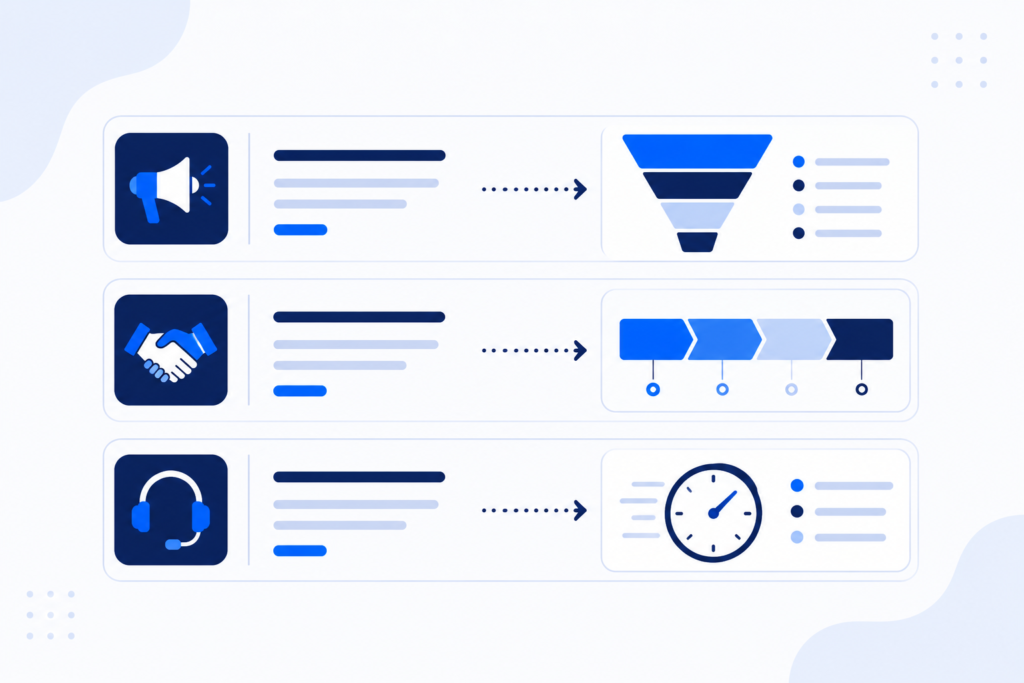
Measuring Three Departments, One Framework
Here’s how the same underlying measurement approach applies across marketing, sales, and support, even though the specific numbers differ.
Common Mistakes When Measuring AI ROI by Department
- Using the same generic metric for every department instead of what that function actually cares about.
- Tracking speed without tracking quality, especially in sales and support.
- Rolling department numbers into one blended figure too early, hiding which department is actually driving results.
- Measuring output volume in marketing without checking whether that content actually performs.
- Ignoring CSAT while celebrating a high deflection rate in support.
Frequently Asked Questions
Why does AI ROI by department vary so much?
Each function has a different baseline, a different core metric, and a different relationship between speed and quality — a support deflection rate and a marketing content-output number simply aren’t measuring the same kind of value.
Which department usually sees AI ROI fastest?
Marketing and support tend to show measurable results fastest, since output volume and response time are easy to track from week one. Sales ROI often takes longer to confirm since it depends on full deal cycles closing.
Should every department use the same AI tools?
No — tool needs differ enough by function that most businesses end up with a small, department-specific stack rather than one universal platform.
Conclusion
A single company-wide number will always understate your best AI use cases and overstate your worst ones. Measuring ai roi by department — with metrics each function already cares about — is what actually tells you where to expand and where to pull back. Start with whichever department has the clearest baseline already in place.
📌 This article is part of our Business Growth Strategies series on ROI. It supports our pillar guide, How to Measure AI ROI in Your Business, and pairs with 5 Signs Your AI Investment Isn’t Working for when the numbers don’t look right.