

Adoption and results aren’t the same thing — best AI tools for finance and accounting is a search that’s exploded, but the results tell a more complicated story than the hype suggests. According to Deloitte’s Finance Trends 2026 report, 63% of surveyed finance teams have fully deployed and are actively using AI solutions, yet only 21% report a clear, measurable return on investment. The tools are getting adopted faster than they’re getting properly evaluated.
This guide covers the finance and accounting AI tools worth considering — invoicing, expense management, and forecasting specifically — matched to where they actually move the needle, not just where they’re easiest to demo.
Why Finance Adoption Is Outpacing Proven Value
Finance has some of the most repetitive, rules-based work in any business — categorizing transactions, reconciling accounts, chasing invoices — which makes it an obvious early target for AI. That’s exactly why adoption moved fast. But "deployed" and "delivering measurable ROI" are different milestones, and most finance teams are stuck between the two.
Closing that gap usually comes down to matching the tool to a specific, measurable finance task rather than adopting AI broadly across the whole function at once.
How to Choose the Best AI Tools for Finance and Accounting
- Which specific task is costing the most hours? Invoicing, reconciliation, and forecasting are different problems with different tools.
- Does it integrate with your existing accounting software, or does it create a second system to reconcile against?
- Can you audit its decisions? Finance tools need explainable output more than almost any other category.
- What’s the real cost including review time, not just the subscription price?
- Does it have SOC 2 or equivalent security certification? Worth confirming before connecting financial data.
The Best AI Tools for Finance and Accounting, by Function
Invoicing and Expense Management Tools
AI-assisted invoice processing and expense categorization are where finance teams typically see the fastest, most measurable time savings — often the first place a finance AI investment actually shows up in fewer hours spent on data entry. This category is deep enough that we’ve covered it separately in our guide to the best AI tools for invoicing and expense management.
Financial Forecasting Tools
Predictive forecasting tools help finance teams model cash flow and revenue scenarios using historical data patterns, moving planning from a quarterly spreadsheet exercise toward something closer to continuous. Our dedicated guide to the best AI tools for financial forecasting covers the leading platforms in depth.
Reconciliation and Anomaly Detection Tools
AI-powered reconciliation tools match transactions across systems automatically and flag anomalies that might indicate errors or fraud, catching discrepancies far faster than a manual monthly review typically would.
Tax Preparation and Compliance Tools
For standard, well-defined returns, AI tools can meaningfully cut preparation time, freeing accountants to focus on the complex tax strategy and advisory work that still requires genuine professional judgment.
The AI Finance Stack, Mapped to the Workflow
Here’s how these categories line up against the actual stages money moves through in a typical finance function.
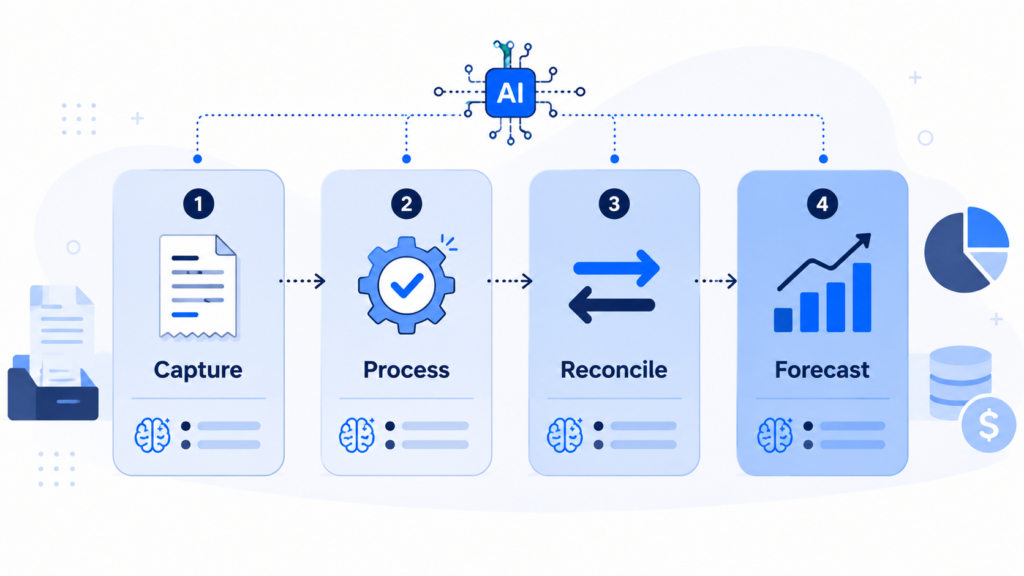
| Function | What It Solves | Where to Start |
|---|---|---|
| Invoicing & Expenses | Data entry, categorization, approval routing | Invoicing & Expense Tools |
| Forecasting | Cash flow and revenue modeling | Forecasting Tools |
| Reconciliation | Transaction matching, anomaly detection | Accounting-software-native AI |
| Tax & Compliance | Standard return preparation | Tax-specific AI platforms |
Common Mistakes When Choosing AI Tools for Finance
- Deploying broadly before proving ROI on one specific task, which is exactly the gap Deloitte’s research surfaced.
- Skipping security certification checks before connecting financial data.
- Trusting AI-flagged anomalies without human review on anything above a routine threshold.
- Choosing a tool that doesn’t integrate with existing accounting software.
- Not measuring hours saved against a real baseline, making ROI impossible to actually confirm.
Frequently Asked Questions
What are the best AI tools for finance and accounting in 2026?
It depends on the function: dedicated platforms for invoicing and expenses, separate tools for forecasting, and accounting-software-native features for reconciliation. Most finance teams need at least two of these working together.
Is AI accurate enough to trust for financial data?
For routine, well-defined tasks like categorization and standard reconciliation, generally yes with spot-checking. Complex tax strategy, audit judgment, and anomalies still need human review before acting.
Can a small business afford dedicated finance AI tools?
Yes — many of the leading platforms in this category offer tiered pricing well below enterprise rates, and small and medium businesses are actually the fastest-growing segment of AI finance tool adoption right now.
Conclusion
There’s no single tool that covers the entire finance function well. The best AI tools for finance and accounting in 2026 are chosen function by function — invoicing, forecasting, reconciliation, and tax — matched to whichever task is costing you the most time or the most risk right now. Start there, measure the result honestly, and expand once it’s proven.
📌 This is the pillar guide for our Best AI Tools series on finance. Go deeper with Best AI Tools for Invoicing and Expense Management and Best AI Tools for Financial Forecasting.